
ARTICLE
Insight
2026/02/17
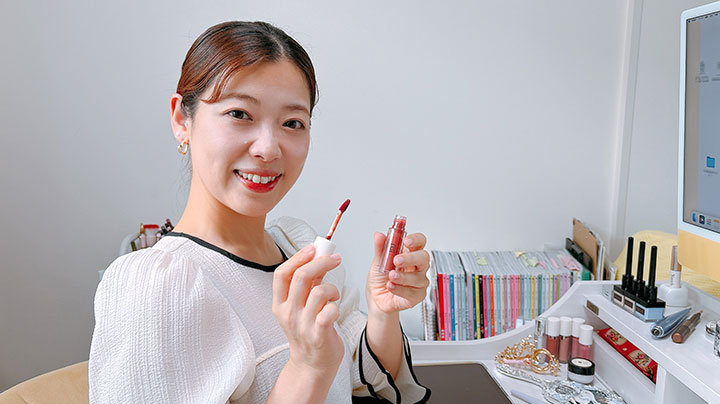
INTERVIEW 【Review of ampule magazine Vol.15】by Beauty Journalist Kyoko Ukai
“INNOVATION & COLLABORATION” was the theme we delivered.『ampule magazine Vol.15』
Following up on the previous issue, we asked an industry expert for their thoughts after reading it.
We requested a review from beauty journalist Kyoko Ukai. She touched on episodes from the magazine’s founding while also providing a wonderful review that included insights on past feature themes and implications for the industry as a whole.
WRITER PROFILE

UKAI KYOKO

Beauty Journalist & Editor-in-Chief of &kitto
Scent Diagnostician (Olfactory Response Analyst)
Host of TBZ Teen Beauty Seminar
Council Member, Japan Femtech Meister Association

Served as an editor for beauty magazine MAQUIA (Shueisha) for 13 years since its launch. After earning an MBA, has provided beauty advice and served as a judge for best cosmetics awards across numerous media outlets. Editor-in-Chief of “&kitto,” a plant-based word-of-mouth platform media launching December 2025. Conducts “Scent Diagnosis (Olfactory Response Analyst)” for companies, universities, medical institutions, and media to visualize the balance of skin, body, and mind through scent. Since 2022, she has hosted the “TBZ Teen Beauty Seminar,” an event teaching teens proper beauty practices. Drawing from her own experience spending ¥300,000/month on beauty products in her 20s and 30s, and testing approximately 120 brands/month of new products for 25 years, she also conducts trend seminars.
I vividly remember the shock when ampule launched during the COVID-19 pandemic.

“This isn't just about knowing the cutting edge of beauty—it's a new media platform where everyone can become a reformer with lofty aspirations!”

At that time, I had graduated from the editorial department of MAQUIA, a beauty magazine I'd been with since its launch, and was in my second year at Waseda Business School. Interacting with classmates of diverse professions, ages, and nationalities, I acutely felt how narrow my previous worldview had been and how skewed my concept of beauty was. I was actively seeking diversity.

It was ampule, encountered while I was burning the midnight oil—sleeping just three hours a day—devouring papers and related information for my master's thesis, that broadened my horizons.

Though I was a conservative who consciously avoided social media, I recognized how its proliferation was changing the process by which products became hits. I also worried that social media was lowering the age at which people started pursuing beauty, leading Generation Alpha to develop skin issues from incorrect beauty practices (I later launched the “TBZ Teen Beauty Seminar” in 2022 to teach teens proper beauty care).

The spread of the coronavirus also prompted a reevaluation of beauty values. More people began seeking “one product for me” rather than “beauty for someone else,” and I keenly felt the rise of personalized skincare.

Beauty industry trends became fragmented by diversity, making it difficult to pinpoint one major wave. Amidst this, K-Beauty emerged as a significant wave. Starting with cushion foundations, it continued with derma cosmetics inspired by aesthetic medicine, ingredient-focused beauty, and makeup items that caught the eye with their visuals, unique tools, and application methods. Its influence was so great that Japanese cosmetics companies visited Korea to investigate the secrets behind its popularity.

It's catchy, beauty is fun, I want to share it—amidst that excitement, I also felt a slight sense of loneliness as Japanese cosmetics were being pushed aside.

Amidst this, ampule's J-Beauty feature.
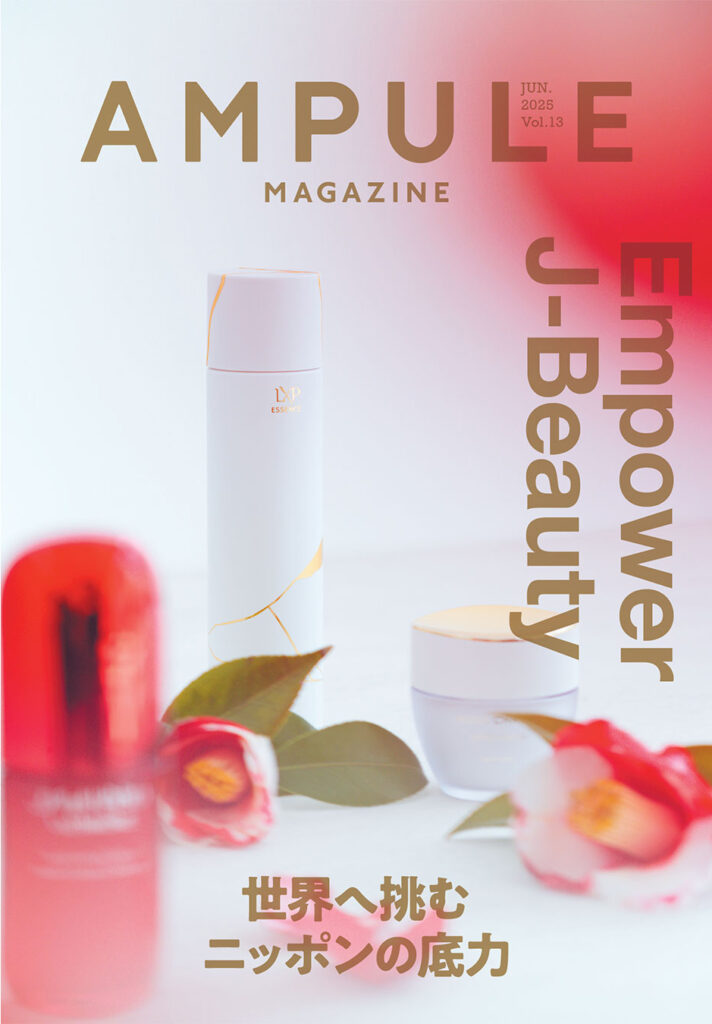
Japan's strength lies in its deepening foundational research that explores “Why?”. Decades of diligent accumulation of basic research has led to Nobel Prize wins.

Korea's strength lies in its ability to strategically and marketing-wise put trends into practical use.

With its solid foundation in basic research, Japan should also be able to develop that knowledge to answer “How?”. This likely involves timing, speed, visuals, and storytelling.

Respect for Japan's climate, materials, and technology.
Wellness orientation, health and longevity.
Functional fragrances.
Fermented skincare.
In recent anti-aging care: cellular aging, mitochondria, autophagy.

Don't you think we're moving toward a more essential direction?
We sense a new form of beauty emerging.
The opening dialogue between Arata Iura and Takanobu Katashiki in Vol. 16 delved into the essence of the matter.

Mr. Iura is driven by a fundamental desire to protect his family and those around him. He continually asks: What causes skin issues even when switching skincare products? Are we just adding more—like excessive packaging or inventory? What is service fundamentally about?

Mr. Katashiro believes that rather than learning from competitors' success stories, if we pursue our own timeline and values to the fullest, the concept of competition itself might disappear.

In my over 20 years of experience observing companies entering the beauty industry from other sectors, I've seen many who thought “beauty is profitable” or “results come quickly.” The beauty business is a unique world where even temporary hits rarely sustain long-term success. Function and emotion are inseparable; especially in skincare, a long-term perspective is crucial, built upon narrative and explanatory elements.

Amidst this, Mr. Katashiro firmly believes beauty businesses take root over 10 or 20-year cycles. Having achieved success in apparel first, he understands the differences between apparel and beauty. Recognizing areas often overlooked, he has grown a makeup brand and expanded into beauty by acquiring heart relation—a subsidiary handling items like feminine care products under Ms. Haruna Kojima. He remains someone to watch.

Both beauty and apparel ultimately lead back to the soil. Mr. Imamura, founder of Flowfushi (developer of UZU's Mote Mascara and Mote Liner), has dedicated himself to soil cultivation since stepping down as president. The global outdoor brand Patagonia has long engaged in activities nurturing the soil.

Mr. Iura established a farm facility in Kyushu capable of handling everything from cultivation to distillation.

Inspired by Mr. Iura's words about “how to blend the soil,” Mr. Kataishi shared in ampule that his own business might now return to its roots.

Cosmetic brands that grasp the essence and move forward are likely to increase in the future.
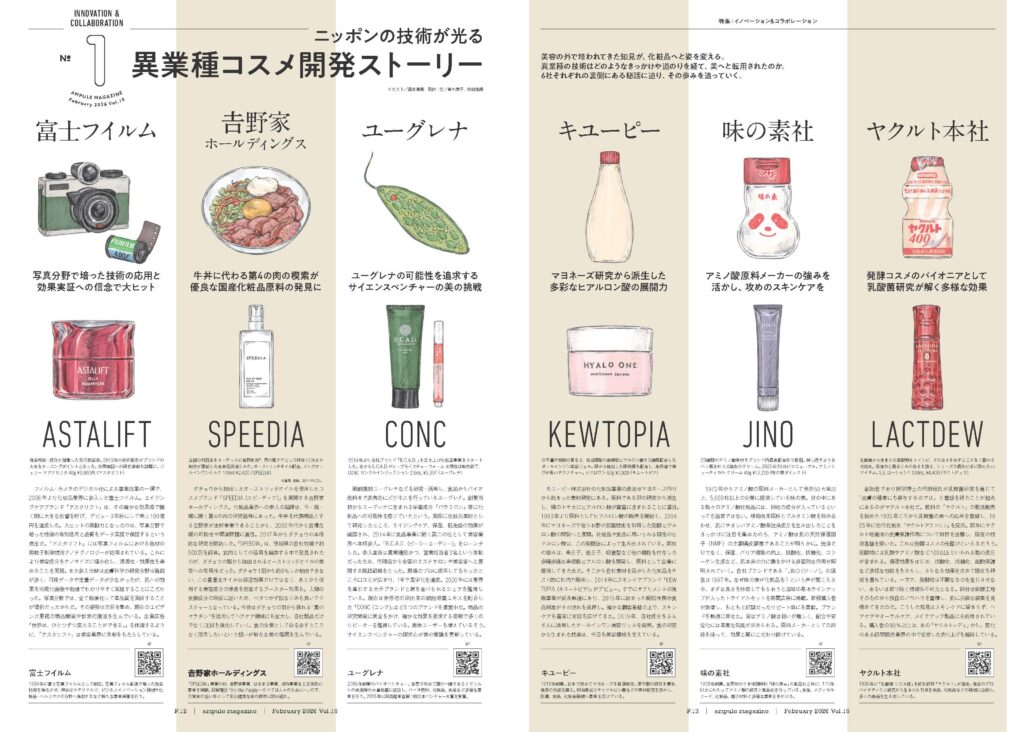
A fascinating feature for both businesses and consumers: “Japan’s Technology Shines: Cross-Industry Cosmetics Development Stories”
Earlier, I touched on basic research and applied research.

The feature “Japan's Shining Technologies: Cross-Industry Cosmetics Development Stories,” highlighting brands where applied research has borne fruit, offers fascinating insights for both companies and consumers.

Among these, Fujifilm stands out. While advancing research to prevent photographic film degradation, they discovered that half of the film's composition is collagen. This led them to enter the healthcare sector, where their products now account for 30% of their sales. I believe a key factor behind this success is the persistent effort to communicate the technology developed by researchers clearly and repeatedly—using images and data—to media and consumers without a science background.

Another example is Yoshinoya Holdings.
While Yoshinoya is famous for its beef bowls, did you know they also offer an ostrich bowl? Focusing on global food shortages, they started raising ostriches at a farm in Ibaraki Prefecture, noting the meat's similarity in taste to beef. Speaking of ostriches, their feathers yield oils rich in hydrolyzed keratin and other moisturizing agents. This led to the creation of a skincare brand utilizing these highly penetrating oils.

Companies that developed unique ingredients and entered the beauty industry from other sectors are now contributing not only to their own brands but also to skincare solutions across the market.
Finally, the article “Looking Back at Why It Went Viral: 2025’s Masterpiece Collaboration Items”
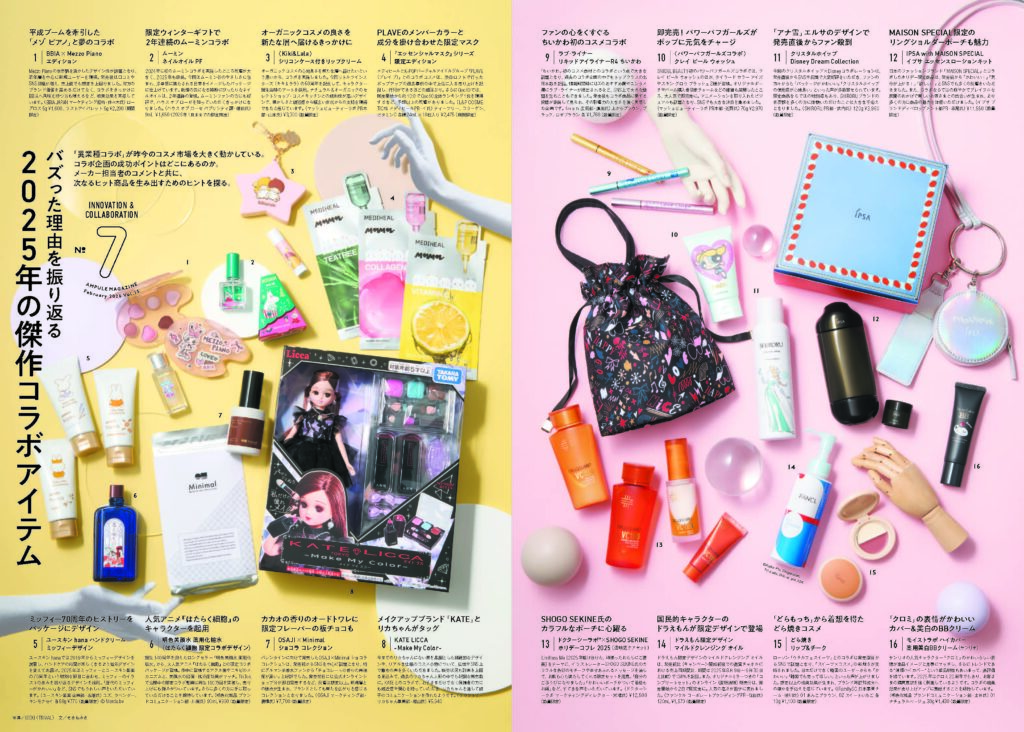
Collaborations serve as a strategy for companies to acquire new customers, while for consumers, they offer an exciting form of communication where they can feel thrilled by their favorite characters while also experiencing the exhilaration of discovering new beauty products.

Collaborations that introduce new skincare products and offer affordable trial opportunities bring benefits such as fans purchasing multiple items, buying gifts, and increased social media posts.

However, is the collaboration meaningful?

This is the key point. Consumers' hearts are moved when there is affinity between the brand and the character, shared elements in their stories, or some point of connection.

A visually rich 14 pages.

After reading ampule, it possesses a mysterious power that inspires not just input, but also the desire to take action yourself.
Beauty Journalist
Kyoko Ukai